Corporate Profile
Founded at the dawn of the 1980s personal computer explosion, Source 2 International operated at the epicenter of tech manufacturing out of 3920 Freedom Circle, Santa Clara, California.
During a period defined by unstable tech logistics—where factory lines swung rapidly between crippling component shortages and massive overstock gluts—Source 2 fundamentally altered standard distribution. Instead of building physical warehouses and amassing slow-moving hardware stock, the firm pioneered the International Component Exchange, functioning as a high-speed, inventory-less information clearinghouse tailored to match component buyers and sellers globally.
Founders & Key Personnel
Robert Solomon
President & VisionaryBuilt Source 2 from a regional Santa Clara independent brokerage into a high-capacity international trading outfit, securing vital global trademark protections and expansive North American sales lines.
Kirk Jensen
Vice President & Co-FounderManaged day-to-day transaction frameworks on the central Santa Clara trading floor, engineering the complex logistical pathways required to manage gray-market components safely.
Fred Richey
Director of Information SystemsThe principal Systems technologist who engineered, maintained, and optimized the Data Center and networks that enabled real-time transactions for the international exchange.
Data Center Technology Stack
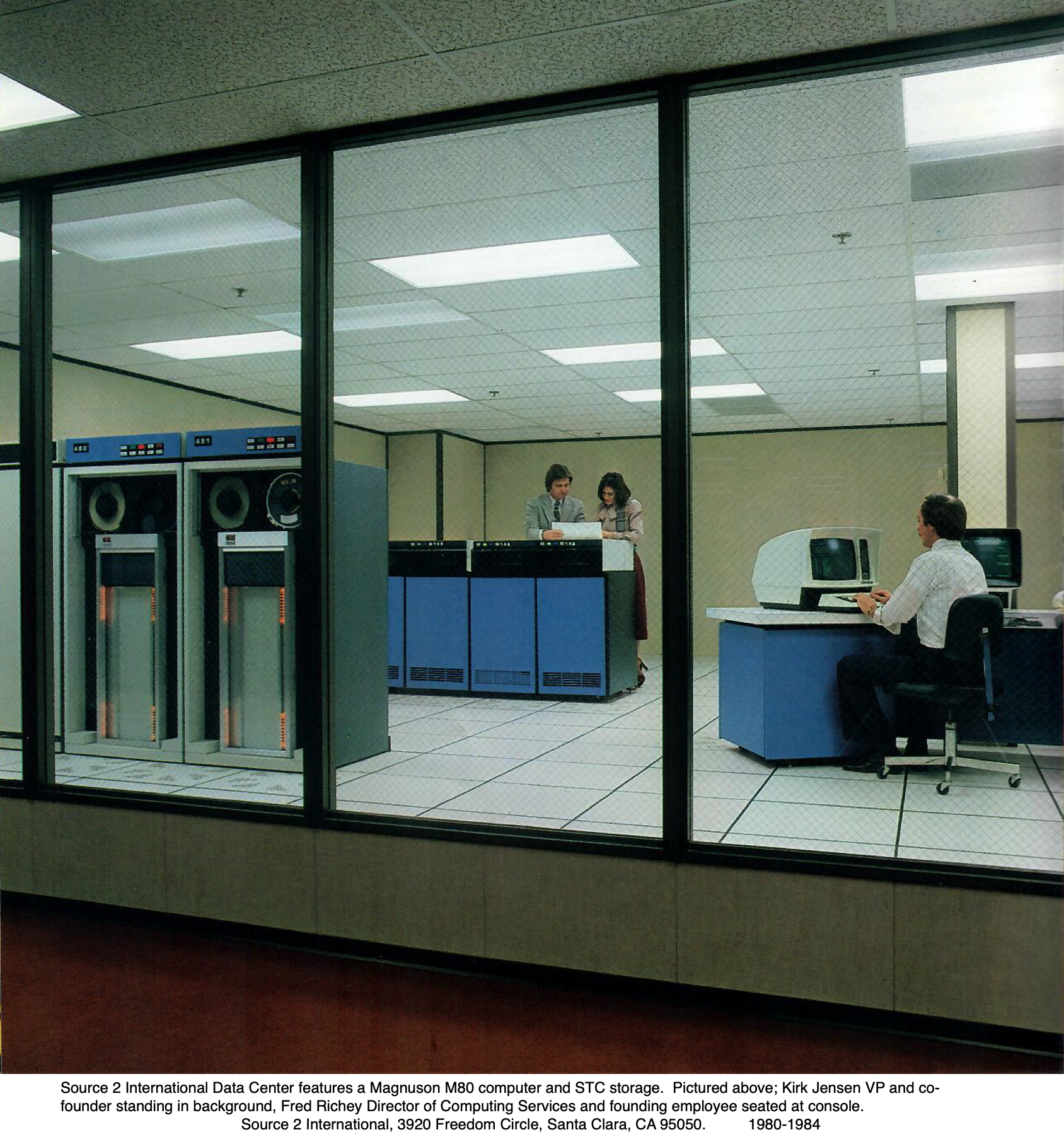
Hardware deployedTo support a fast-moving trading environment, Fred Richey engineered a highly cost-conscious, high-performance hardware stack that bypassed expensive IBM pricing models while maintaining "big iron" processing power.
- The Mainframe Core (Magnuson M80): Source 2 deployed a San Jose-built Magnuson M80 series plug-compatible mainframe computer. The M80 natively executed IBM operating systems and software at a fraction of the hardware cost, serving as the central computing engine for the entire national exchange.
- The Telecommunications Link (Paradyne Channel Extenders): Mainframe architectures of the era suffered physical limitation for "bus & tag" data cables. Fred bypassed this bottleneck by deploying Paradyne PIX (Parallel Interface Extender) hardware. This system serialized data over dedicated telecom circuits treating remote locations as if they were local.
- The Endpoints (ITT Courier 270 Terminals): Brokers interacted with the exchange via ITT Courier 270 series block-mode "green screen" terminals (IBM 3270-compatible). The firm rapidly added broker desks across its offices at full local-channel speeds without requiring expensive IBM front-end communications processors.
- The Data Storage Peripherals: Storage Technology Corporation (STC) peripherals like the STC 3600 tape drives and STC 8350 disk storage subsystems offered clear strategic, financial, and operational advantages.
The software environment was designed for high-concurrency, mission-critical transaction speeds, utilizing the exact platforms favored by Wall Street banks and major airlines:
- IDMS (Integrated Database Management System): Cullinet's network-model database engine was leveraged for its blistering data-pointer speeds. It allowed the system to instantly map highly complex component relationships (cross-referencing part numbers, speed grades, packaging types, and varying OEM locations) far faster than early relational databases could.
- CICS (Customer Information Control System): This powerful transaction monitor managed the incoming data traffic from all remote offices. CICS revolutionized enterprise computing by shifting mainframes from overnight batch processing to instant, real-time transaction processing. Its primary advantages included developer efficiency, immense scalability, and robust system reliability for massive networks of "green screen" terminals.
- COBOL: The core business logic, financial calculations, and file processing routines were written entirely in COBOL, providing a rock-solid, highly reliable framework for the fast-paced trading floor.
You can view the following Source Records & Press releases
Explore original articles, marketing booklets, and physical document prints scanned and preserved on the Internet Archive: